
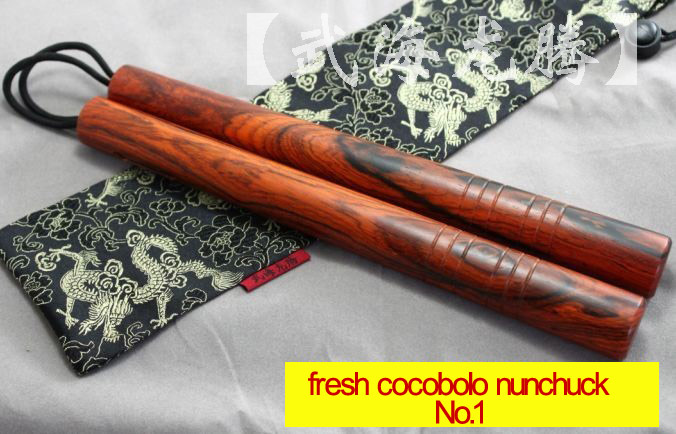
If you have ever held a pair of mass-produced nunchaku and felt they were missing something—weight, warmth, character—you are not alone. Many practitioners eventually arrive at the same conclusion: wood matters. And among the world‘s most coveted hardwoods, few rival cocobolo. The Fresh Cocobolo Nunchaku embodies what happens when a master-grade exotic wood is shaped into a functional martial arts weapon—a piece that feels alive in your hands, ages with grace, and performs as beautifully as it looks.
What Is Cocobolo? Understanding the Wood Behind the Weapon
Cocobolo (Dalbergia retusa) is a tropical hardwood native to Central America, prized for centuries by master craftsmen across multiple disciplines. Its reputation extends far beyond the martial arts world: cocobolo is the wood of choice for custom high-end cue sticks, police batons, fine gun grips, knife handles, and premium musical instruments—especially guitars, drums, and basses where tonal warmth and resonance are paramount.
What elevates cocobolo above ordinary hardwoods is its combination of aesthetic brilliance and mechanical performance:
Extraordinary hardness backed by measurable data. Cocobolo registers a Janka hardness rating of 2,960 lbf (14,140 N) —placing it among the world‘s densest and most durable hardwoods. For context, this significantly exceeds common nunchaku woods like oak or beech. Its natural oils give the wood exceptional resistance to moisture, decay, and insect attack, which is why cocobolo outdoor furniture and marine applications can last for generations with minimal maintenance.
Color that deepens with age, not fades. When freshly cut, cocobolo displays vibrant yellow-orange tones streaked with red, purple, chocolate, and saturated black accents. Over weeks and months, natural oxidation transforms these hues into deeper, richer oranges and reds, until the wood stabilizes into a warm, complex patina. As the product listing notes: “if you keep it for several decades, it may become dark color because of oxidation”.
A naturally oily surface that feels warm to the touch. Unlike finished hardwoods that require synthetic lacquers or varnishes, cocobolo‘s high natural oil content allows it to take an exceptionally fine polish directly on the raw wood. The result is a smooth, almost waxy surface that provides a secure grip without feeling tacky—an essential quality for nunchaku handling. When polished, cocobolo displays a natural luster that no synthetic finish can replicate.
A distinctly pleasant floral scent. Even well-seasoned cocobolo heartwood retains a subtle, sweet fragrance—an unexpected sensory dimension that adds to the wood‘s mystique.
Fresh vs. Aged Cocobolo: Understanding the Distinction
One unique detail about the Fresh Cocobolo Nunchaku is right there in the name: fresh. This refers to recently cut and shaped cocobolo that has not yet undergone the full oxidation process that older, aged stock has experienced. The current listing features the “Fresh” variant, which arrives with brighter, more vibrant tones—yellows, orange-reds, and lighter streaks that will gradually darken over years of ownership.
For those who prefer a more settled, maroon-black appearance from the start, the shop also produces old cocobolo wood nunchaku —four variants in total across fresh and aged stock. Worth noting: this particular fresh cocobolo model may experience temporary out-of-stock periods, as the workshop sources wood in small batches to maintain quality. If interested, contacting the shop directly to confirm availability is recommended.
There is something quietly satisfying about owning the “fresh” edition: you are not just buying a finished product—you are witnessing the beginning of a decades-long aging journey, watching the wood deepen and mature in tandem with your own practice.
Specifications at a Glance
| Detail | Specification |
|---|---|
| Wood | Fresh Cocobolo (Dalbergia retusa), Central American tropical hardwood |
| Stick Length | 28 cm (approximately 11 inches) |
| Rope Length | 13 cm, adjustable |
| Weight | 350 g (balanced for both flow practice and striking drills) |
| Taper | 2.5 cm – 2.9 cm (ergonomic profile that narrows toward the rope end) |
| Price | $229.99 |
Who Is This Nunchaku For?
The Fresh Cocobolo Nunchaku occupies a deliberate middle ground. It is not an entry-level training tool for absolute beginners (who are better served by foam or lighter wood options), but neither is it a display-only curiosity destined for a shelf. It is built for practitioners who have moved beyond the basics and seek a weapon that rewards skill, and for collectors who recognize cocobolo as a legitimate investment-grade exotic wood.
For the Serious Martial Artist
Training with nunchaku develops precision, rhythm, hand speed, and ambidextrous control. Wooden nunchaku, particularly those crafted from dense hardwoods, offer sensory feedback that synthetic materials cannot match: the weight transfer through each swing, the tactile connection between palm and grain, the subtle balance shifts that signal proper technique. The 350-gram weight of the cocobolo nunchaku sits in a versatile sweet spot—heavy enough to provide meaningful feedback during flow drills, yet light enough for extended practice without excessive fatigue.
Nunchaku training also builds coordination, wrist strength, and hand-eye reflexes that translate across martial arts disciplines. For advanced practitioners, the weapon‘s precise balance and secure grip become critical as techniques grow more complex. A well-made wooden nunchaku becomes an extension of the body, and cocobolo’s natural grip properties make it particularly well-suited for fast, fluid manipulation.
For the Collector and Connoisseur
Beyond performance, cocobolo nunchaku function as legitimate collectible art objects. Each pair is inherently one of a kind: no two pieces of cocobolo share identical grain patterns, color distribution, or figuring. The swirling, marble-like grain—reminiscent of abstract landscape painting—ensures that every nunchaku tells its own visual story.
The global nunchaku market, valued at approximately 187.2millionin2024andprojectedtoreach500 million by 2035, reflects growing demand across martial arts, fitness, and collectible segments. Within this expanding market, exotic wood variants consistently appeal to advanced practitioners and collectors seeking premium quality. Cocobolo, given its scarcity and protected status under CITES regulations, occupies a particularly desirable niche.
3 Buying Tips for Exotic Wood Nunchaku
1. Know Your Wood: Natural Variation Is a Feature, Not a Flaw
Exotic hardwoods like cocobolo are not factory-uniform materials. Color intensity, grain orientation, and figuring vary naturally from piece to piece. A nunchaku with dramatic black streaks is not inferior to one with more uniform orange-red tones—it is simply a different expression of the same wood. Embrace the uniqueness.
2. Verify Adjustability
The Fresh Cocobolo Nunchaku features an adjustable rope (13 cm), allowing you to fine-tune the connection length to match your hand size and preferred handling style. A rope that is too long makes controlled catches difficult; too short restricts fluid transitions between grips. Adjustability means the weapon adapts to you, not the other way around.
3. Understand Availability: Exotic Woods Come in Limited Batches
Cocobolo is not a commodity material cranked out by the ton. It is a CITES-regulated tropical hardwood, harvested in limited quantities, and prices continue to rise with increasing scarcity. This shop produces four cocobolo variants total (fresh and aged), and restocking depends on the workshop‘s ability to source quality raw wood. If this model shows as available, hesitation can mean missing the batch entirely.
Care and Maintenance
Cocobolo‘s high natural oil content makes it relatively low-maintenance compared to other hardwoods, but a few simple practices will preserve its beauty and structural integrity for decades:
- Occasional oiling: Apply a light coat of natural oil (such as lemon oil or pure tung oil) every few months, or whenever the surface begins to look dry. Wipe off excess after 15–20 minutes. The wood‘s own oils do much of the work, but supplemental oiling helps maintain luster.
- Avoid prolonged moisture exposure: While cocobolo has excellent natural moisture resistance, it is still wood. Store in a dry environment. If the nunchaku become wet, wipe them down promptly.
- Sunlight awareness: Cocobolo darkens with oxidation naturally, but prolonged direct sunlight can accelerate color change unevenly. Store away from windows when not in use if you wish to slow the darkening process.
- Watch for skin sensitivity: A small percentage of individuals may experience skin irritation from cocobolo dust or prolonged contact—similar to reactions some people have with poison ivy. This is rarely an issue with finished, polished pieces, but worth noting for those with known wood sensitivities.
Why Cocobolo Deserves a Place in Your Collection
The martial arts weapons market is flooded with mass-produced options in aluminum, plastic, and generic light woods. Cocobolo nunchaku occupy a different space entirely. They are instruments that reward skill on the training floor and appreciate in character over a lifetime of ownership. The combination of measurable hardness, natural grip, aging beauty, and genuine scarcity makes cocobolo one of the few nunchaku materials that serious practitioners and collectors agree belongs in the top tier.
And if you are looking for a piece that bridges that gap—a weapon that trains hard and looks the part—the Fresh Cocobolo Nunchaku deserves a close look.
👉 Browse the wood Nunchaku for sale at Nunchaku1-1.net — or contact the shop directly for availability inquiries, custom requests, or information about the old cocobolo variants. Limited stock runs on small-batch exotic woods, so reaching out early is always worthwhile.